OBERLIN COLLEGE
Gary Kornblith
History 263
Mudd 306; x58526
Fall 2008
gary.kornblith@oberlin.edu
Office hours: Wed., 3:30-5:00 p.m.

The American Civil War and Reconstruction


For the official, up-to-date version of this syllabus, go to http://www.oberlin.edu/history/GJK/H263F08/.

Less than a century after fighting for independence from Great Britain and establishing a federal republic, Americans turned their firearms on each other in the bloodiest war in the nation's history. At the end of hostilities, over six hundred thousand soldiers lay dead while approximately four million former slaves enjoyed legal freedom for the first time. Thereafter Americans struggled to reorganize their society and redefine their polity in response to the changes wrought by the Civil War's violence and to the conflicts that endured in peace.

This course focuses on three interrelated subjects: the causes of the Civil War; the dynamics of the war and emancipation; and the outcomes of the Civil War and Reconstruction. Beyond coverage of this subject matter, the course is designed to promote three major "student learning objectives":

Throughout the semester, students are expected to draw their own conclusions about the meaning and significance of events that continue to provoke popular passions and intellectual argument more than a century after they occurred.

Format: The class meets regularly on Mondays and Wednesdays from 2:30 to 3:20 p.m. and on Fridays from 2:30 to 4:20 p.m. The format of class sessions varies as indicated on the schedule below. Attendance at discussion sessions is mandatory, and students are also required to post on Blackboard before each discussion session.

Evaluation: Students will be graded on the basis of one position paper (5-7 pp.), a research project prospectus (1-2 pp.), a research project progress report (1-2 pp.), an oral presentation of research findings (10-12 minutes), a polished research paper (12-15 pp.), and class participation, including Blackboard postings. The standard formula for determining final grades will be 20% for the position paper, 5% for the prospectus, 5% for the progress report, 5% for the oral presentation, 40% for the research paper, and 25% for class participation. The instructor reserves the right to exercise some discretion in assigning final grades.

Honor Code: All course work is governed by Oberlin's Honor Code. If you have a question about how the Honor Code applies to a particular assignment, you should ask the professor in advance of the due date.

Purchases: The following books are available for purchase at the Oberlin Bookstore.


Coming of the Civil War  
Wed., Sept. 3

Introduction

Fri., Sept. 5


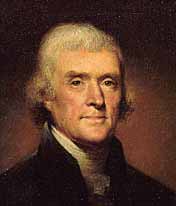
Thomas Jefferson

Discussion: The Problem of Slavery in the Early Republic

  • Gary J. Kornblith, Slavery and Sectional Strife in the Early Republic, 1-97 [available under "Course Documents" in Blackboard]
  • The Missouri Crisis: Selected Primary Documents, i-xxvii [available under "Course Documents" in Blackboard]


Mon., Sept. 8

Lecture: The "Two Civilizations" Debate

Wed., Sept. 10

Lecture: Emergence of Immediate Abolitionism

Fri., Sept. 12


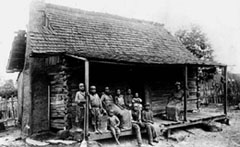
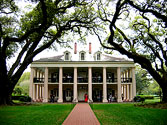
Oak Alley Plantation

Discussion: The Political Economy of the Old South

  • Eugene D. Genovese, The Political Economy of Slavery, 3-39, 85-105, 124-179, 243-274 [purchase]
  • Robert William Fogel, Without Consent or Contract, 60-113 [available under "Course Documents" in Blackboard]
  • Walter Johnson, Soul by Soul, 78-116 [available under "Course Documents" in Blackboard]

Mon., Sept. 15

Lecture: Sectionalism and the Second Party System

Wed., Sept. 17

Lecture: Political Crisis of the 1850s

Fri., Sept. 19


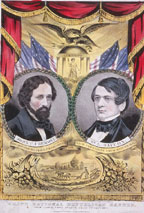
Republican Campaign Poster 1856

Discussion: The Rise of the Republican Party


Mon., Sept. 22

Lecture: A House Dividing, 1854-1858

Wed., Sept. 24


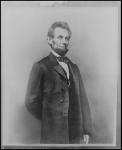
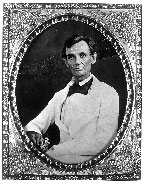
Abraham Lincoln

Discussion: What Abraham Lincoln Believed

  • Don E. Fehrenbacher, ed., Abraham Lincoln, 33-34, 45-46, 51-53, 66-69, 69-70, 71-77, 81-84, 86-88, 88-93, 94-103, 103-112, 112-117, 119-121, 121-128, 132-143 [purchase]

Fri., Sept. 26

Film and discussion: John Brown's Holy War


Civil War and Emancipation  

Mon., Sept. 29

Lecture: A House Dividing, 1859-1861

Wed., Oct. 1

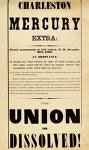
UnionDissolved Broadside
South Carolina Secedes

Discussion: Dynamics of Secession

  • William W. Freehling, The Reintegration of American History, 176-219 [available under "Course Documents" in Blackboard]
  • William A. Link, Roots of Secession, 1-61, 97-119, 149-254 [purchase]


Fri., Oct. 3

Tour of Oberlin's Civil War Monuments (accompanied by Prof. Erik Inglis)


Mon., Oct. 6

Lecture: Preparing for Primary Research (meet in Mudd 113 in the Academic Commons)
Position paper due

Wed., Oct. 8

Lecture: The Transformation of Northern War Aims

Fri., Oct. 10


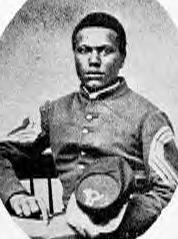
Soldier of Mass. 54th Colored Troops
Sgt. Major John H. Wilson of the
54th Massachusetts Infantry

Film and discussion: Glory


Mon., Oct. 13

Lecture: Home Fronts, North and South

Wed., Oct. 15

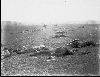
Battle of Gettysburg
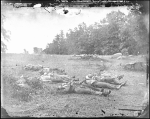
The Dead at Gettysburg

Discussion: Why Men Fought

  • Chandra Manning, What This Cruel War Was Over, 1-221 [purchase]

Fri., Oct. 17

No class
Research project prospectus due


Fall Break


Mon., Oct. 27

Lecture: The Military Outcome

Wed., Oct. 29

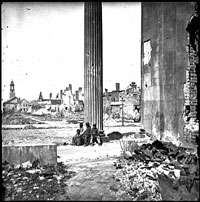
Charleston 1865
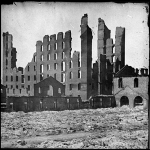
Charleston, South Carolina, early 1865

Discussion: Judging the Means and Ends of War

  • Don E. Fehrenbacher, ed., Abraham Lincoln, 244-245, 277-279 [purchase]
  • James M. McPherson, “No Peace without Victory, 1861-1865,” American Historical Review 109 (Feb. 2004) [in History Cooperative, accessible from a campus computer]
  • Harry S. Stout, Upon the Altar of the Nation: A Moral History of the Civil War, i-xxii, 360-85, 457-461[available under "Course Documents" in Blackboard]
  • Drew Gilpin Faust, This Republic of Suffering: Death and the American Civil War, xi-xviii, 32-60, 171-210, 266-271 [available under "Course Documents" in Blackboard]

Fri., Oct. 31

Film and discussion: Long Shadows


Reconstruction  

Mon., Nov. 3

Lecture: Origins of Reconstruction

Wed., Nov. 5

Contrabands of War
Contrabands

Discussion: Black Experience of War and Emancipation

  • Leon Litwack, Been in the Storm So Long, 104-166 [available under "Course Documents" in Blackboard]
  • Steven Hahn, A Nation under Our Feet, 1-159 [purchase]

Fri., Nov. 7

No class

Students in History 263 are expected to attend Robin D.G. Kelley's keynote address at the "Race and Resistance" symposium, beginning at 4:30 p.m. in King 106; everyone is also encouraged to attend the remainder of the symposium, which runs through Saturday afternoon.


Mon., Nov. 10

Lecture: The Radicalization of Reconstruction

Wed., Nov. 12


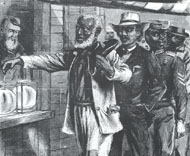
Voting under Reconstruction

Discussion: Black Reconstruction

Fri., Nov. 14

Discussion: Reflections on Primary Reseach
Progress report on research project due
Special presentation by Prof. Jack Glazier


Mon., Nov. 17 Lecture: The Retreat from Reconstruction

Wed., Nov 19

Discussion: Why Reconstruction Failed

Fri., Nov. 21 Film: Birth of a Nation
Sun. Nov. 23 Film and dinner at prof's house (271 West College St.), beginning at 4 p.m.

Mon. & Tue., Nov. 24-25

Individual appointments with professor

Wed., Nov. 26

No class

Fri., Nov. 28

No class


Mon., Dec. 1

Lecture and discussion: Legacies of the Civil War and Reconstruction

Wed., Dec. 3

Student Presentations

Fri., Dec. 5

Student Presentations


Mon., Dec. 8 Student Presentations
Wed., Dec. 10 Student Presentations
Fri., Dec. 12

Student Presentations
Research paper due


American Flag