History 293: Dirty Wars and Democracy
(Fall 2008)
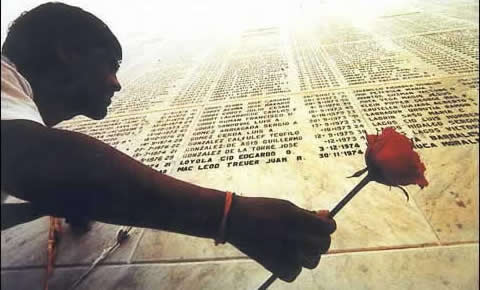
(Inauguration of the Monument
to the Dead and Disappeared, General Cemetary, Santiago, Chile - 1990- La
Nación)
Tuesday/Thursday 9:35-10:50 AM; King 337
Mr. Volk
Office: Rice 309
Office Phone: 58522
Email: Steven.Volk@oberlin.edu
Office Hours: Tues 11-Noon; Wed 1:30-2:30; Thurs 3:30-4:30, and by appointment
Overview:
During the 1960s and 1970s, military
dictatorships surged over the Americas, covering, at one point, every country
in South America save Colombia and Venezuela. While military rulers were not
an unusual occurrence in many Latin American countries, these regimes were
in no sense “typical” military dictatorships. Indeed, they were
striking for the intensely political nature of their aims, and for the economic
approaches they imposed, as well as for the sheer brutality of their methods
which targeted an almost exclusively civilian population. These were the regimes
that gave rise to the term “dirty war,” introduced “disappear”
into our grammar as a transitive verb, and which adapted and invented whole
new lexicons of terror. At the same time, the very concept of a "dirty"
war continues to raise a number of issues:
Aren't all wars “dirty”?
One can certainly question whether there are any wars which don't involve
or target civilian populations, unleash sexual violence against women, or,
to the extent that they are fought by democratic powers, suspend the essential
rules which characterize a democracy. Yet if the majority of wars historically
can be said to have been fought against external enemies (those who
resided on the other side of the border or who were otherwise "externalized"
by virtue of their race, religion, ethnicity, or national origin), the essence
of the "dirty wars" in Latin America is that they were launched
against domestic populations defined by those in power as "foreign"
by virtue of their (presumed) political beliefs.
Don't all states target
domestic populations at various times? While all states hold a (theoretic)
monopoly on the sanctioned use of force, and many will use this force disproportionally
against specific (internal) populations, the "dirty wars" amount
to a significant deployment of brute force intended to terrorize one's own
population.
Many Latin American regimes of
the 1960s and 1970s could fit the model of this "dirty war" state
(which has also been called a “bureaucratic-authoritarian” dictatorship,
a "national security" state, or a "state of exception"),
but here we will concentrate only on the “Southern Cone” countries
of South America, paying particular attention to Argentina, Chile and Uruguay.
Grappling with the issues raised
by the “dirty wars” is not past history in these countries, nor
is it a topic of only marginal relevance in the United States. In terms of
the former, in the past few years a growing number those accused of crimes
committed under the "special circumstances" of the dictatorships
in Chile, Argentina, Uruguay, Brazil, Peru, Guatemala and elsewhere have been
arrested and tried. In terms of the latter, two issues have brought the topic
of the "dirty wars" directly to a U.S. focus. In the first place,
over the last decade, the United States has begun to release thousands of
documents which lend evidence to arguments that the U.S. government helped
bring about and then support Latin America's dictators. Secondly, it is increasingly
clear that Washington, in its efforts to pursue its own concept of national
security, has adopted tactics distressingly similar to those used in the Southern
Cone countries during the "dirty wars": torture, detention without
charges or limits, disappearances, cross-border rendition, the amplification
of executive power at the extense of legislative power, the increase of government
secrecy, the expansion of warrantless domestic spying, etc. Clearly, to quote
William Faulkner, "The past is never dead. It's not even past."
(Requiem for a Nun)
Course Objectives:
*To understand the nature of
the state and its varous forms, why states move toward "exceptional"
forms, and the importance of understanding regime differences within capitalist
state frameworks;
*To gain a stronger background
in the histories of Chile, Argentina and Uruguay in the second half of the
20th century; the different contexts which gave rise to exceptional regimes
in those countries; the different ways in which the exceptional states organized
themselves and found support, and, ultimately, the different ways in which
they came to an end.
*To better understand the complex
nature of resistance to dictatorship;
*To think about issues of memory,
justice, and the recreation of civil society after times of trauma;
*To think critically about history,
its contemporary uses, and what one can learn from a study of the past.
Course Organization:
Classes will be held as lecture-discussions,
with student participation actively encouraged. The course requires a significant
amount of reading, and students are expected to keep up with the readings
so as to be able to participate intelligently and energetically in class.
HIST 293 Blog: As a supplement
to this course, I am managing a blog at: http://languages.oberlin.edu/hist293/.
I intend the blog to be used for a number of purposes: (1) To provide up-to-date
news about "dirty war" issues; (2) to give you a chance to share
ideas, insights and perspectives in the informal environment of a blog; (3)
to allow you to share your work, bibliographies, and other useful resources;
and (4) to move your discussions from the classroom to the larger world.
HISP 293 - Dirty Wars LxC [Languages
across the Curriculum]: Concurrent to this course, we are offering a one-credit
course [HISP 293-01 - Dirty Wars LxC Section, CRN: 8115] to allow students
to study and discuss course materials in Spanish. The section, which will
meet once a week (tba), will be led by Patrick O'Connor from Hispanic Studies.
It will require additional reading in Spanish, discussion in Spanish, and
writing in Spanish. If you are interested in the course, you need to register
for it separately from HIST 293 (although you cannot register only
for HISP 293).
Assignments: Besides
keeping up with the readings and participating in the blog, when possible,
there are three main assignments in the class:
October 14: The Way In: Exploration
of the political and rhetorical arguments of "exceptional" regimes.
[7-page paper due at the beginning of class]
November 25: One of three topics:
The National Security State; The Internationalization of the Dirty Wars;
or The Way Out. [7-10 page paper or project due at the beginning of class]
December 18: Briefing book to
Congress. [10-15 page document due no later than 11:00 AM]
-
First Paper: 20%
-
Second Paper/Project: 30%
-
Briefing Book/final project:
40%
-
Class Participation, attendance,
etc.: 10%
NOTE: All papers and projects are due on
the day and at the time specified in the syllabus. Papers/projects turned
in late without an explicit extension will be graded down one grade step
for each day that they are late. For example. A paper due on October 14
which would have received an A- if turned in on time would get a B+ if turned
in on October 15, a B if turned in on October 16, a B- if turned in on October
17, etc. It is always your best option to discuss any issues regarding turning
in work with me as soon as you know there may be a problem.
There will be NO extensions allowed on the
final paper/project unless you apply for an official incomplete in the course.
If your final project is turned in after 11:00 AM on December 18 without
an official incomplete, it will not be read and will get an "F".
An official incomplete will ONLY grant you an extension for the final project.
All other late work for the course MUST be turned in by December 15 or it
will NOT be graded.
Plagiarism: "The
word plagiarism derives from Latin roots: plagiarius, an abductor,
and plagiare, to steal. The expropriation of another author’s
work, and the presentation of it as one’s own, constitutes plagiarism
and is a serious violation of the ethics of scholarship." [American
Historical Association, Statement on Standards of Professional Conduct].
As much as I would like to say that plagiarism doesn't occur at Oberlin, I
encounter at least one, if not more, serious incident each semester. It is
always very straight forward: students copy sections of other texts and attempt
to pass them off as their own work. Copying the work of others goes against
everything that a liberal education is about. It is a serious affront to the
other students in the course, to me as instructor, and to the plagiariser
him/herself. For further information on plagiarism at Oberlin, see the student
Honor
Code, pg. 1. If you have questions about what constitutes plagiarism,
particularly in the context of joint or collaborative projects, please see
me or raise it in class.
Students
with Disabilities:
Appropriate
accommodations will always be granted to students with documented disabilities.
Any questions about the necessary process of documenting disabilities should
be addressed to Jane Boomer, Coordinator of Services for Students with Disabilities
(Peters G27-28; x5-5588).
Books Recommended for Purchase
All required readings are available
in the Reserve Room of Mudd. Some (see the syllabus) are available in electronic
copies posted on the course site in
Blackboard. Additional copies of the books in the course can be obtained
through OHIOLink -- just make sure you request them with enough time. The
following books have been ordered for the bookstore and can be purchsed there
as well as at on-line booksellers. Vendors such as Amazon (linked here) often
offer used versions.
Luz Arce, The
Inferno: A Story of Terror and Survival in Chile, trans. Stacey
Alba Skar (Madison: University of Wisconsin Press, 2004.
Ariel Dorfman, Death
and the Maiden (NY: Penguin), 1994.
Marguerite Feitlowitz, A
Lexicon of Terror: Argentina and the Legacies of Torture (NY: Oxford
University Press), 1999.
Alicia Partnoy, The
Little School: Tales of Disappearance and Survival in Argentina,
2nd ed. (Cleis Press), 1998.
Naomi Roht-Arriaza, The
Pinochet Effect: Transnational Justice in the Age of Human Rights
(Univ. of Pennsylvania Press), 2006.
Steve J. Stern, Battling
for Hearts and Minds. Memory Struggles in Pinochet's Chile, 1973-1988
(Durham: Duke University Press), 2006.
Peter Winn, Weavers
of Revolution: The Yarur Workers and Chile's Road to Socialism (NY:
Oxford University Press), 1989.
Syllabus
| Sept 2, 4 |
| Introduction: When the World
Goes Mad |
| Sept. 9, 11 |
Reading |
| Chile - "Pre-History"
- The Socialist Challenge |
Peter Winn, Weavers of
Revolution: The Yarur Workers and Chile's Road to Socialism (NY: Oxford
University Press), 1989. |
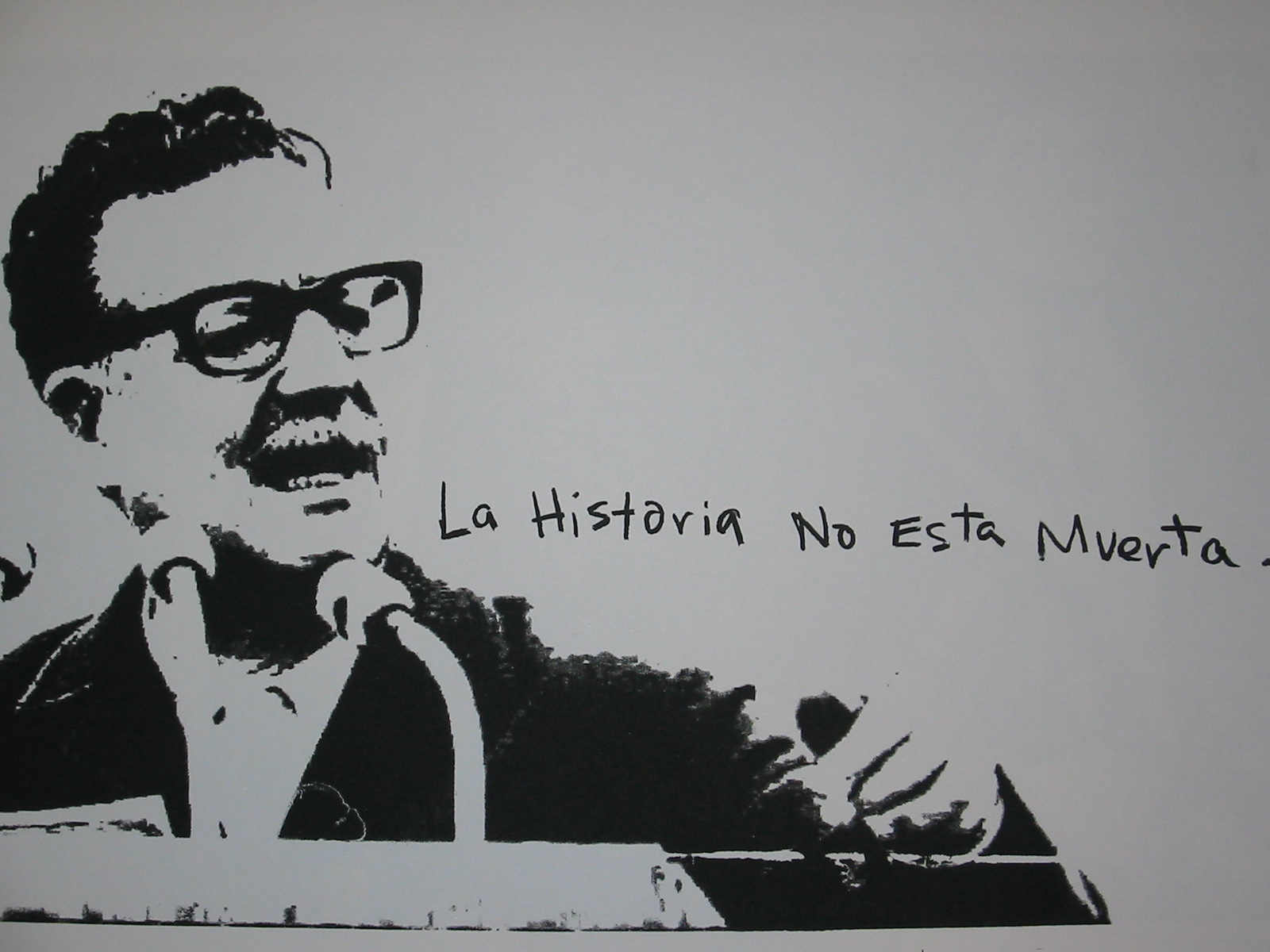
(Salvador Allende, "History
isn't dead" - student project, Oberlin College, 2003)
| Sept. 16, 18 |
Reading |
| Chile - The Foundational Years |
Steve J. Stern, Battling
for Hearts and Minds. Memory Struggles in Pinochet's Chile, 1973-1988
(Durham: Duke University Press, 2006), Part I - to pg. 245.
|
| Sept. 23, 25 |
Reading |
| Sept 23: Argentina - "Pre-History"
- The Collapse of Civil Society |
Martin Edwin Andersen, Dossier
Secreto: Argentina's Desaparecidos and the Myth of the "Dirty War"
(Boulder, CO: Westview Press, 1993), pp. 23-172. (Available in Blackboard
and Print Reserves) |
| Sept. 25: Guest Lecture: Hiber
Conteris (The Revolutionary 1960s in Latin America) |
|
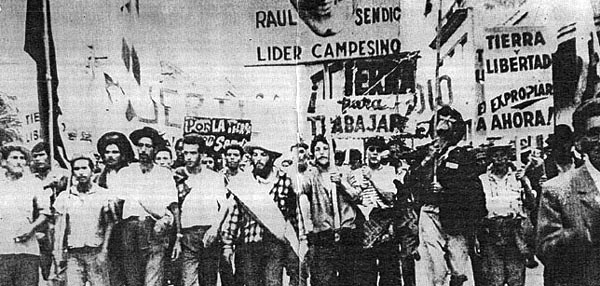
(Tupamaro march, Uruguay)
| Sept. 30 (no class), Oct 1 |
Reading |
| Argentina - The Foundational
Years |
Marguerite Feitlowitz,
A Lexicon of Terror: Argentina and the Legacies of Torture (NY: Oxford
University Press, 1999), Introduction, Chapters 1 & 2 (pp. 3-88). |
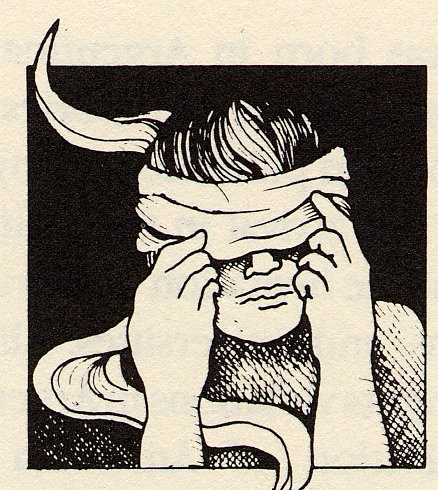
(From Alicia Partnoy, The
Little School)
| Oct. 7, 9 (no class) |
Reading |
|
Uruguay - The Foundational Years
(Guest Lecture: Patrick O'Connor)
|
Lawrence Weschler, "Liberty,"
in A Miracle, A Universe (Chicago: University of Chicago Press,
1990), 83-172. [Blackboard and Print Reserves]
Jeffrey Ryan, "Turning on Their
Masters: State Terrorism and Unlearning Democracy in Uruguay" in
Cecilia Menjívar and Néstor Rodríguez, When
States Kill: Latin America, the U.S., and Technologies of Terror
(Austin: University of Texas Press, 2005), pp. 278-304. [Blackboard
and Print Reserves]
Mauricio Rosencof, "On Suffering,
Song, and White Horses," and Hiber Conteris, "On Spatial and
Temporal Exile: Expatriation and Prison Life," Saúl Sosnowski
and Louise B. Popkin, eds., Repression, Exile and Democracy: Uruguayan
Culture (College Park, MD: University of Maryland, 1987), pp. 120-132;
190-195. [Blackboard and Print Reserves]
|
| October 14: First Assignment
due at the start of class: The Way In. Each military dictatorship legitimizes
its own rise to power, most often arguing that its seizure of power was
intended to "save" democracy. Using a single country (Chile,
Argentina, Uruguay or Brazil), analyze the political and rhetorical claims
of the military as they took (and held) power. [7 pgs based on secondary
and (where possible) primary sources] |
| Oct. 14, 16 |
Reading |
|
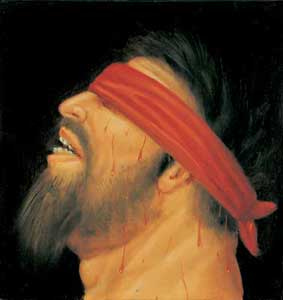
The National Security State
|
Ariel C. Armony, "Producing and
Exporting State Terror: The Case of Argentina," in Cecilia Menjívar
and Néstor Rodríguez, eds., When States Kill: Latin
America, the U.S., and Technologies of Terror (Austin: University
of Texas Press, 2005), 305-331. [Blackboard and Print Reserves]
Alicia Partnoy, The Little School:
Tales of Disappearance and Survival in Argentina, 2nd ed. (Cleis
Press), 1998.
Please familiarize yourselves with the
United
Nations Covenant against Torture and Other Cruel, Inhuman, or Degrading
Treatment or Punishment.
Additional reading (recommended but not
required): The "Bybee
Memo." The Bybee Memo is one of a series of memos prepared
for the Bush Administration that laid the legal groundwork for the torture
of prisoners in Iraq, Afghanistan, and at Guantanamo. It was written
by largely by John Yoo, but signed by Jay C. Bybee. Both were lawyers
in the Office of Legal Council. the office which provides legal counsel
to the Attorney General.
[Fernando Botero, "Abu Ghraib #66"
(2005)]
|
| Oct. 28, 30 |
Reading |
| Narratives of Survival |
Luz Arce, The Inferno:
A Story of Terror and Survival in Chile, trans. Stacey Alba Skar (Madison:
University of Wisconsin Press, 2004), Parts I & II. [Note: read over
fall break] |
| Nov. 4, 6 |
Reading |
| Chile: The Road
Out |
Steve J. Stern,
Battling for Hearts and Minds. Memory Struggles in Pinochet's Chile,
1973-1988 (Durham: Duke University Press, 2006), Part II. |
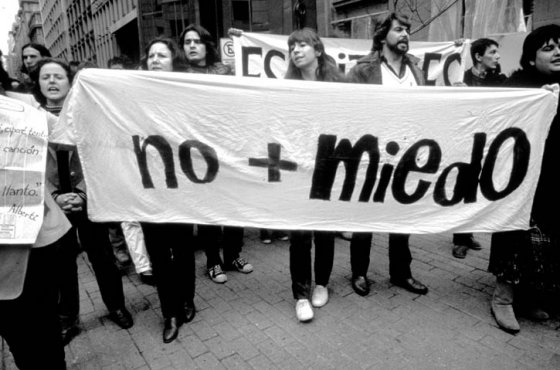
("No más miedo" (No More Fear
) - Santiago, 1988)
| Nov. 11, 13 |
Reading |
| Argentina: The Road Out |
Marguerite Feitlowitz, A
Lexicon of Terror: Argentina and the Legacies of Torture (NY: Oxford
University Press, 1999), Chapters 3 to end. |
| Nov. 18, 20 |
Reading |
| Transitional Justice: The
Problems of Justice in a World of Terror |
Ariel Dorfman, Death and
the Maiden (NY: Penguin), 1994. |
|
November 25: Second Assignment due at
the beginning of class: The project can be on any of the following three
themes:
(1) Terror, violence, and the exceptional
regime: While different states allow different amount of legally sanctioned
violence within their constitutional structures (including the use of
capital punishment), constitutional states largely eschew the use of
torture and non-judicially sanctioned capital punishment. Your projects
should explore the theme of violence and the exceptional regime, including
an exploration of the hazy area between legally sanctioned violence
and extra-legal violence.
(2) The internationalization of the "dirty
wars" regimes. This project can explore relations between two or
more Southern Cone dictatorships (e.g. Chile and Argentina), Operación
Condor, or the relationship between the United States and any particular
Southern Cone dictatorship.
(3) Contesting the dictatorships: This
project can focus on any single or comparative examination of the ways
in which the dictatorships of the Southern Cone were challenged, resisted,
and (ultimately) removed.
You may approach this project as a group
project which will involve 3-4 people per group, or as an individual
project. The format of the project is open — it can be a written
paper, a performance, a video, or any other media form. If you choose
to write a paper, it should be 7-10 pages in length
|
| Nov. 25, Dec. 2, 4 |
Reading |
|
Transitional Justice: Prosecuting Dirty
War Criminals
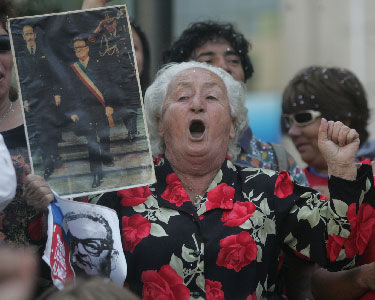
(Pro-Allende demonstrators
celebrate Pinochet's death, Santiago, Dec. 12, 2006)
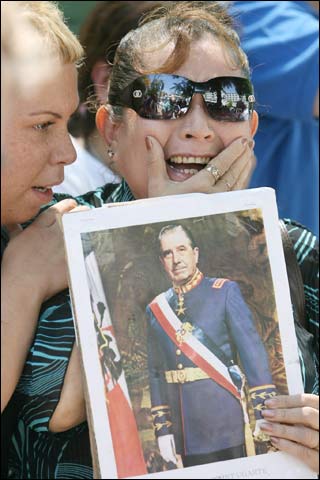
(Pro-Pinochet demonstrators
mourn Pinochet's death, Santiago, Dec. 12, 2006)
|
Naomi Roht-Arriaza, The Pinochet Effect:
Transnational Justice in the Age of Human Rights (Univ. of Pennsylvania
Press), 2006. (pgs. to be assigned)
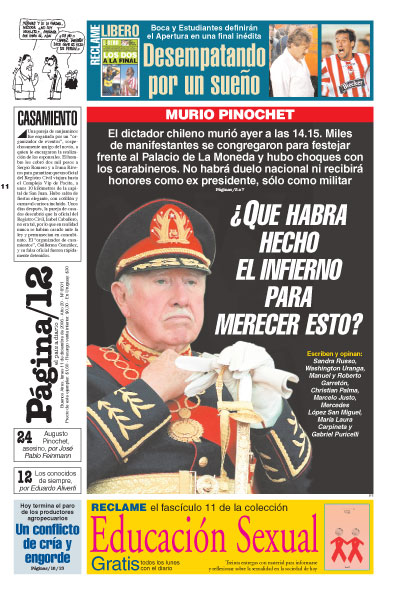
(Headline of Buenos Aires
daily announcing Pinochet's death: "What has hell done to deserve
this?")
|
| Dec. 9, 11 |
Reading |
| The Lessons of the Dirty Wars:
History Matters |
Recommended:
Jane Mayer, The Dark Side. The Inside
Story of How the War on Terror Turned into a War on American Ideals
(New York: Doubleday), 2008.
See Jane Mayer's discussion of how
the popular Fox TV show, "24," portrays torture.
|
| December 18: Final Project
due no later than 11:00 AM: Briefing book for Congress. Your task for
the final paper is to write a briefing book directed to the foreign policy
aides of an incoming U.S. Senator or Congressperson. It will be your decision
whether you actually send this briefing book to the member of Congress,
but you will be writing as if you will send it (i.e., your purpose
is to be informative and educational, not to be persuasive/rhetorical,
although, I would imagine that you will be interested in expressing a
specific point of view). You will be writing as a historian (not as a
policy person), as someone who has studied the purpose, methods, and outcomes
of dictatorships in various Latin American countries. Your purpose is
to draw lessons from those experiences and provide the "advice of
history" to a new Congress. Your arguments can be directed to the
abstract lessons learned during the "dirty wars" period, to
U.S. policy during that period, or to both. But you will most critically
have to engage with the questions of the lessons of history, when and
how they are applicable to a different context, a different purpose. ["Briefing
Books" should be approximately 10-15 pages long. Further information
will be given on format and other aspects of writing.] NOTE: There will
be no extensions on this project unless you request an official incomplete
in the course. Projects not turned in on time without an official incomplete
will not be graded.] |