


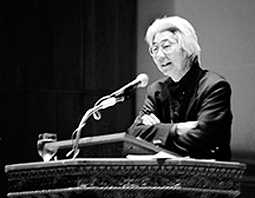
 Professor of Ethnic Studies at the University of California at Berkeley Ronald Takaki spoke about the struggle for multicultural education at a campus convocation Tuesday.
Takaki's lecture, "The Crucible of the Culture Wars," reviewed the history of the struggle for multicultural requirements and Ethnic Studies at Berkeley, as well as the need for ethnic studies in a well-rounded education. "We are being invited to see multiculturalism as an ... intellectually exciting project," he said.
"I thought he had some very good things to say in regards to the academy and in curricular development," President Nancy Dye said. The Finney Lecture Committee, The President's Office and other sponsors brought Takaki to commence the Spring semester.
"We are experiencing the most serious racial crisis in America since the Civil War," Takaki told the audience toward the beginning of his address. He cited the end of the Cold War, the increasingly globalized economy and the "suburbanization of industrialization" among others as examples of the crisis.
Takaki dedicated a good deal of his speech to the struggle of students and faculty at Berkeley to get a more multicultural focus in the curriculum of that institution. He said that in the 70s, as the make-up of the University population shifted dramatically to minority groups, the University had no choice but to shift as well.
He said that students at Berkeley told the faculty through protests and action to "Look at our faces. We are not represented in your classes."
As a result, the faculty and administration of Berkeley were forced to ask themselves what an "educated Californian" should know for the twenty-first century. They debated the question for two years, amid numerous student protests and demonstrations, finally instituting amulticultural requirement in 1989.
Takaki stressed that students were important in the University's decision to create an Ethnic Studies department and a multicultural requirement.
Takaki also talked about the way in which multiculturalism should be incorporated into a curriculum.
He said that a multicultural component should have a strong comparative component, and include not only the four "major racial minorities," but also marginalized European ethnic groups such as those in Eastern Europe.
As an example he gave a short "lecture within a lecture" as an example. In the lecture he used examples from history, sociology and economics which demonstrated the multicultural influences of the country.
In the "lecture" he discussed the non-essentialist and fluid characteristics of identity, and the formation of ethnic multiplicity in his discussion of an 1870 labor dispute. The dispute involved Irish immigrants being replaced by Chinese workers and a 1903 union that involved Mexican and Japanese workers.
The question-and-answer session after the speech lasted less than one hour, and Takaki fielded questions dealing with issues ranging from Oberlin's multicultural requirement and ethnic studies programs to how to respond to multiculturalism's critics.
Student reaction to the talk is mixed.
Takaki's speech, the second all-campus convocation of the year filled only about two-thirds of Finney Chapel, a significantly smaller crowd than the first, which featured cultural critic Cornel West.
"Ten Toes" talks: Ron Takaki, who was known during his surfer days as "Ten Toes Takaki," focused on more serious matters of multicultural education during his Tuesday night speech in Finney. (photo by John Matney)

Copyright © 1997, The Oberlin Review.
Volume 125, Number 13; February 7, 1997
Contact Review webmaster with suggestions or comments at ocreview@www.oberlin.edu.
Contact Review editorial staff at oreview@oberlin.edu.