
Starting in the summer of 1996, the city of Oberlin began the process of bringing student off-campus housing up to fire codes. Although 28 out of 33 rooming house owners have updated their smoke alarms and fire escapes, apartments and sublets have not been addressed.
Approximately 800 students live off campus, 500 in apartments or sublets. It is unknown how many apartments and sublets are up to code. Rooming houses must be registered with the city, but sublet rooms do not require a license. This prevents the city from separating students from town residents and ensuring their fire safety.
The College provided the city with a list of all students living off-campus, but since apartments and sublet owners are not required to comply under city and state codes, the city cannot legally do anything.
Rooming house owner Harold Gibson has made the changes, but does not agree with the city's policy. Gibson believes regulation should be the same for apartments, sublets and rooming houses.
Gibson said, "I believe all places, whether they rent to one student or 20, have a responsibility to give students a safe place to live. There are places called apartments and duplexes that wouldn't pass the codes. The city knows that. Students know that. I'm not telling you anything new. From the beginning of 1996 until August 31 of 1996 the rooming houses that kept five or more people had absolutely no fires. During the same time, places with less than five people that have not been inspected have had 44 percent of the city's fires."
Starting in June of 1996, when new City Manager Rob DiSpirto arrived, the city of Oberlin began an evaluation of the fire safety of local rental property. First he made sure all rooming houses were licensed with the city, then he started evaluating them for safety. Dennis Kirnan, Oberlin's fire chief, has been meeting with the 33 owners to set a minimum standard of safety. They have been trying to identify what meets the city code, decide if the state code is applicable and what measures are required under state code.
All rooming houses must now have electric smoke detectors (not battery-operated ones attached to a wall) on each floor and all need to be interconnected. Thus, if the smoke alarm goes off in the basement, the smoke alarm on the first floor goes off as well.
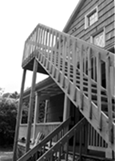
The codes also require a staircase for escape. Although this has been a law since 1977, most houses have ladders nailed to the side of a house or to trees.
"One doesn't want students to have to go out of the window, go across the snow-covered roof, and climb down a ladder in the middle of the night," Gibson said.
"Five of the home owners do not believe students need anything else. They refuse to make the improvements. Students have a right to a safe environment, and it is the responsibility of the home owners to provide it," Kirnan said.
"Fire escapes seem excessive. I haven't even checked to see if we have an alarm," senior Sonja Krefting said.
Senior Rob Pinson also doubted the need for fire escapes. "We only have two floors. I'm sure I could jump out the window if I had to, but I wouldn't want to," he said.
Up to par: The city and College have been enforcing fire codes in all off-campus student housing. (photo by John Matney)
Copyright © 1997, The Oberlin Review.
Volume 126, Number 2, September 12, 1997
Contact us with your comments and suggestions.