
It remains to be seen whether $65 million is too much to ask for the sake of science. For the past two years, science faculty, administrators and architects have been meeting regularly to hash out the details of what is to become the largest capital project in Oberlin's history.
The building is being designed by Payette Associates, an architectural firm that has designed science facilities and hospitals at institutions around the country. The $65 million bill includes $40 million for construction, $15 million for associated project costs and $10 million for a maintenance endowment.
The building will accommodate increased student research and house a large lecture hall that will be used for both meetings and movies. A 4,600 square foot common space is also slated.
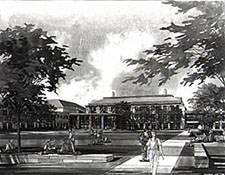
Before the Science Center was officially conceived, some campus leaders were dreaming of a new student union. But that dream has not yet been realized. However, one of the primary goals of the planners of the science center was to create a common space in the building that would have the effect of enlarging Wilder Bowl.
"We wanted to make sure this wasn't just a science fortress," Director of Sponsored Programs David Love said. "This is not only a science building, it's an Oberlin College building. It's going to make a great deal of difference to this campus."
One of the highlights of the building, and what planners hope have potential for wider community use, is the increased size of the Science Library and the addition of a commons. The new Science Library as it is currently planned will occupy 12,580 square feet, 123 percent larger than it is today.
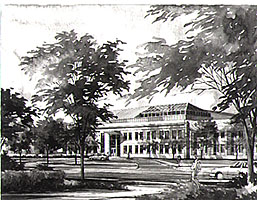
The library will occupy the space that is currently the south end of North Quad. It will span from the sidewalk that extends from the east end of Kettering to the Kettering breezeway.
Science Librarian Alison Ricker explained, "The library will be highly visible from the street. From north to south you'll be able to see straight through."
A wall of windows will stretch across both the north and south ends of the building. A bay window will arch into North Quad and the opposite side will look out onto an open area facing Lorain Street.
Above the Science Library will be the Chemistry Department. The department will see only a three percent growth in area, but the facilities will be more equipped to handle high tech materials and equipment that the discipline currently demands.
Professor of Chemistry Albert Matlin was optimistic. "This will completely turn around what is going on in the sciences," he said about the project. "This will be enormous."
Some planners are worried that the crux of gravity will plague the building in the future. Ricker said chemical leaks are bound to happen, but the architects are taking the necessary precautions to divert any accidents away from library resources. For example, every pipe that runs through floors will be coated with a material that expands with heat to seal off any leak that may occur.
The schedule of events planned for the construction of the building has been meticulously orchestrated to avoid the need for temporary classroom space to be built. As it currently stands, preliminary ground breaking is scheduled to begin next summer with the demolition of the south wing of Barrows.
Actual ground breaking will then be Sept. 1, 1999. The Chemistry Department and Science Library will be built first, adjacent to the current Kettering. Concurrently a research wing will be constructed down Woodland Street.
After approximately one year of construction, the library and Chemistry Department will move into the new building. The Biology Department will then move into the current chemistry wing for a temporary stay while their current wing is renovated. The renovation of Wright Physics building will happen simultaneously. After the Biology wing is renovated, Biology will relocate to its old homebase.
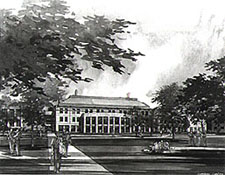
In 2002, the final phase of construction ensues. The walls of the chemistry wing of Kettering and the science library will fall that year, leaving an open space for the entire campus to claim as its own, not just north campus residents.
"We recognize that Lorain Street is very much a barrier. We've tried out many scenarios, but neither a cross over nor a tunnel seemed practical," Love said.
Love hopes the lawn that opens up to the new science building will be inviting enough. "We think that the very openness of this look will attract people across. We are still toying with the notions of a pedestrian crossing. Even a light. But that remains a problem to be solved," Love said.
The Board of Trustees has approved the building plans throughout the course of planning. A capital campaign was launched a year ago to raise money for this and other capital projects. The Trustees will vote again on the plan as it now stands at their September meeting.
Love said, "Until you have a final design it's difficult. I think now we will go into high gear."
Future visions: The drawings on this page show different angles of the science center, as it has been conceived by architects. (graphics courtesy David Love)
Copyright © 1998, The Oberlin Review.
Volume 127, Number 3, September 18, 1998
Contact us with your comments and suggestions.