
Congratulations are in order for the new student senators.
They are college junior Atif Aziz, college first-year Christopher Anton, college sophomore Adrian Leung, college sophomore Erica Dicker, college first-year Liane Lau and college first-year Jesse Bloom. Nineteen candidates ran for the six open spots.
Since last Thursday, Senate has been urging students to enter their votes for this Fall's election. "For any election, the Senate must collect votes from 20 percent of the student body," said retiring Senator junior Sarah Stein-Greenberg. "That is about 600 students." They finally succeeded in gathering the required number of votes Thursday.
Senator-elect Bloom said Wednesday, "I was surprised that on a campus as socially concerned as Oberlin the minimum number of votes hadn't been reached."
According to Senate bylaws, election balloting lasts for five days, but is extended if quorum is not reached. This year, gathering votes was more difficult than previous years because a convenient method of vote collecting was lost. The old mail server, Alpha 2100, was replaced early this year. As a result, only paper ballots could be submitted.
Under the old system, when a student logged onto the server, there was a VOTE option. The Senate collected 200 to 300 votes on-line per election or referendum when Alpha was running.
Alpha's old voting program will soon be replaced by a web-based voting system. According to Associate Computer Systems Manager Everett Doner, a working prototype could be tested in late October and will definitely be in operation by spring.
The original program was set up by the Computing Center but maintained by the Student Senate. This would also be the case with the new program. "We would give them the product and as much consulting time as they need, but other than that they're on their own," said Doner.
Stein-Greenberg sighted other uses for the new program. "We could do a poll a week," she said. As for the student body involvement in self-government, candidates were blunt. "I think the biggest problem in this campus is apathy," said Senator-elect Anton.
Part of the student apathy comes from lack of communication on the part of the candidates. Senator-elect Lau said, "It would be better if people actually knew why we were running."
"A big problem with voting is name recognition. People feel no stake in the election," said Bloom.
Candidates offer many possible solutions to the lack of interest in Senate elections. "Debates are a nice idea, but I'd be concerned about the voter turnout," said Lau.
Ten of the Senate candidates submitted statements to the Review and Oberlin Online. "The paper helps a little bit, but only to those who take reading it seriously," college first-year candidate Joseph Andriano said.
"Most of the people I talked to didn't even know what Student Senate was," Lau said.
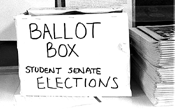
Vote: A near-empty ballot box sits in Wilder. The abscence of an electronic voting system made it difficult for Senate to reach quorum in the recent elections. Nevertheless, the votes are in. (photo by Heidi Good)
Copyright © 1998, The Oberlin Review.
Volume 127, Number 3, September 18, 1998
Contact us with your comments and suggestions.