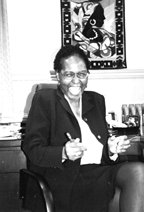

When Deb McNish talks, she looks you straight in the eye. She never glances around the room, never over your shoulder, and certainly not down at the ground. The interim dean of students, who will be leaving Oberlin at the end of the month to become Earlham College's dean of student development, is the most forthright, honest and straightforward administrator Oberlin has. And she is leaving.
McNish said that when she was talking to Earlham's president about working there, she asked him, "Can you deal with me being honest? Could you deal with me saying 'No, I don't think so, Mr. President?"
McNish values her honesty. She said if there is one thing that she wants Oberlin to know about her as she gets ready to leave, it is that she is open, honest and frank.
As a manager, she said she expects and looks for honesty in everyone she works with. "If a subordinate doesn't say what he really feels, what good is he?" she asked. "I've got to be in an environment where honesty is prized for itself - truth for truth's sake."
Honesty is so important to McNish because it leads to learning and growth. When she thinks about her job, McNish thinks she is here to help people grow and learn about themselves. "Whether it is YB, a 46-year-old woman, a 24-year-old staffperson, or a 21-year old RC, it all comes down to growth and development," she said. "It is about people realizing that everything isn't black and white, that there is a give and take."
Instead of seeking to enforce rules and maintain order, she seeks the cause of problems, and works to eliminate misunderstandings that lead to conflicts.
Earlier this year when students were caught growing marijuana in their South Hall dorm room, McNish worked with them to come up with an appropriate reaction. They ended up doing planting for the College grounds.
McNish feels comfortable in conflict, because it is an opportunity for people to be honest and learn from each other. Growing up in a family of eight children, she said conflict has never scared her. "Conflict is not a problem," she said. "The ultimate goal is to have the people involved learn something."
McNish isn't exempt from this learning. Oberlin has taught her volumes since she has been here,
"I can't talk enough about what Oberlin has done for me, with me, about me," she said.
McNish appreciates the honesty she sees in students as well. "Students are honest to the core. They haven't learned to lie with their mouths and their faces at the same time yet," she said. "You can tell when something isn't sitting right with them."
Her history
McNish wasn't very excited to come to Oberlin. She and her husband, Clifton, were settled in jobs at Eastern Michigan University when then-dean Pat Penn began recruiting McNish to come to Oberlin.
The two were at a conference, where McNish was giving a presentation. Penn was so impressed by her that he asked her to come to Oberlin to be director of residential life. McNish declined since she and her family were settled in Michigan.
Later that year McNish received another phone call from Penn, this time offering her a position as assistant dean. She decided to take it.
McNish arrived in Oberlin a veteran in student affairs and more importantly, a veteran in people affairs. Growing up "one of eight" as she repeatedly put it, her Detroit-based family was managed with the same honesty as she displays today.
"My mother was so frank," she said. "And with people I know, I am that frank."
She went to Michigan State and majored in biology, hoping to go into nursing. After finding that the hospital was not where she wanted to be, she went into graduate school in student personnel, concentrating in counseling. As a grad student she began working in the counseling center, a job she held for a few years after she graduated. There she found a mentor who epitomized the energy and fun-loving spirit she brings to student life today.
"He's still in my life because he was such a great guy. We named our son after him," McNish said.
After another stint as a career counselor, McNish moved to Eastern Michigan University to be a hall director. She held that job for nine years, and earned a reputation among the student life community. This is when McNish caught Penn's eye.
Her first position was assistant dean, but within a year she was promoted to director of residential life.
"My first year here was so horrible that I was going to leave," McNish said. Ironically, it was this adversity that makes McNish feel Oberlin is a special place. "I hadn't been in such a challenging environment. I thought I had, but I hadn't. Oberlin forces you to take a stand about you - what you are."
It is this environment, with its competitiveness and academic character that McNish felt helped her shape her career.
"It has formed my work to the degree that I cannot be ignored in my field anymore," she said. "It bridged the work with who I am."
While McNish feels challenged by Oberlin, her subordinates are challenged by McNish. Interim Director of Residential Life Yeworkwa Belachew, YB, said that McNish is a demanding boss, because she expects people to push themselves in the same way that she pushes herself.
Despite her personal growth, McNish's years here have not always been smooth. During the summer of 1997, she was fired from residential life only to have the move rescinded when former Dean of Students Charlene Cole-Newkirk resigned in October of that year.
YB said that when she first heard that McNish had been fired, she was very upset. Seeking something to make herself feel better, she eventually hit on one thing that would improve with McNish gone. "I knew I wouldn't have to work as hard," she said.
Her future
McNish hopes that she can find the same kind of challenging environment at Earlham that she has found at Oberlin.
"Oberlin is extremely competitive, but in a way I appreciate because the competition is with yourself. Can I be the best I can be? I don't think any other place has taught me that."
McNish hopes to bring some of this spark to Earlham. She said that when she spoke to Earlham students on a visit, they were surprised to hear about the kinds of student activism at Oberlin. McNish told a story about her visit to Earlham: "They said 'why can't we do that,' and I said I'm sure you can."
McNish explained that overcoming challenges - including exploring civil disobedience - was part of exploring boundaries and eventually growing.
"If you move to the place where you're afraid to go and get comfortable there, then everything in between becomes free for creativity," she said.
YB is confident that Earlham will benefit from McNish. "When I think about her leaving and get sad, I just think about how lucky Earlham is. She is going to mesmerize them," she said.
Despite the fact that McNish has high hopes for Earlham, she is going to miss Oberlin - its students, environment and atmosphere.
"The one thing I know I'll miss is the beauty of Oberlin. The walk through Tappan, looking at Peters; I could have on high heels and still want to walk through the grass," she said.
McNish won't be the only one doing the missing. Her loss will be a sore subject for those who have had the opportunity to work with her.
Joe DiChristina, associate dean of student life, came to Oberlin the same week as McNish. "I came to Oberlin as a greenhorn, and she had 20 years of residential life experience," he said, "but she has always treated me with respect."
Over the years he has spent working with McNish, DiChristina has learned that McNish is someone who has achieved balance as a manager and as a person.
"She knows when to be a person, when to cry, when to show her faults. That's a strength," DiChristina said.
Deb McNish: The interim leaves lots of friends behind. (photo by Jake Schlesinger)
Copyright © 1999, The Oberlin Review.
Volume 127, Number 24, May 14, 1999
Contact us with your comments and suggestions.