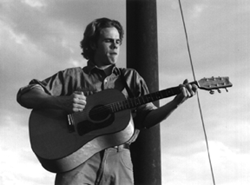

In an all out clash of rock and roll titans, Tyler Kord, from Scenes From the Next, got a chance to interview living folk legend Josh Ritter. Ranging in topics from cowboy songs, to dog grooming, this week's In The Kitchen takes at the man behind the image: Josh Ritter.
Tyler Kord - Ladies and Gentlemen Josh Ritter. Josh, thanks for being here. Before we start with the ordinary questions, the biggest question is two albums, Josh, two albums?
Josh Ritter - We decided we didn't want to stop with the best folk album of the year, we wanted the two best folk albums of the year. We thought the best way to do that would be to make the second album.
T.K. - Sweet. "Josh Ego Ritter." (laughs) But really, what was the deal?
J.R. - Well I did this first album with some guys - Zack Hickman, Tom Graves, Darrius Zelkha, and Zach Williamson recorded it. We got Sean McFaul to master it. It was awesome. It was basically a bunch of songs that I wanted to record and the studio was here and for free and we just did it. It was fun.
T.K. - But then where did the second one come from?
J.R. - The second one was this collaborative project that we did from this band Scenes From the Next. (laughs) No, for the second one Chris Baymiller asked us if we wanted to record something because he wants to get moving in the music business, and so we did that. Me and Bridget Matros and Guy Mendelow.
T.K. - And how would you describe the second album?
J.R. - The album is like fast pirate songs and random women folk artists. (laughs)
T.K. - Well, what else can we ask? What are your main influences?
J.R. - There is this one band, Scenes From the Next, a big influence. Seriously though, they are awesome. It is good to see music that has thought behind it and not being pretentious about it.
T.K. - Oh, sheesh. (blushing) Stop.
J.R. - In the past year I have really gotten into Silver Jews, Pavement. Tom Waits a lot. Medeski Martin and Wood. Also the Pogues, Nick Cave, but definitely Tom Waits.
T.K. - You going to start smokin' cigarettes?
J.R. - Yeah, I was actually thinking about it, tearing my vocal chords down a little bit.
T.K. - How about this. Next Year? Plans for after Oberlin?
J.R. - I'm going to go to Providence, and basically there are several multi-million dollar contracts that are sitting on my doorstep already.
T.K. - That's to be expected.
J.R. - And I'm recording a single with Prince next year.
T.K. - Helping him come back?
J.R. - Yeah, soon I'll be the artist formerly known as Josh Ritter. But I'll be in Providence trying to market the album. I'm doing a tour of Seattle, Portland, and San Fransisco at the end of July and the beginning of August, and then coming back here and play a bunch of Ohio schools in September, trying to make a name in those areas.
T.K. - Have you sent the album out to anyone yet?
J.R. - I haven't sent it to any labels yet but I've sent it to a bunch of places to review. It is still in the works for reviewing. It takes about three months. But still, the Cleveland Free Times reviewed it and they liked it a lot so, things are going well. It is really fun.
T.K. - So what's your take on the stigma of the solo folk artist?
J.R. - Wussies. There are tons of wussies and a ton of really horrible people. And even the people who make it really big are not necessarily the best ones. So I think that folk music is what I have said the music is here, in Oberlin, but I don't want to get stuck in playing folk, I want to be doing something where I'm doing what I want to do. If you have to market it as folk than that's good, but if you want to something good you have to go with your own intuition. So I don't really see the music that I want to do going specifically in the folk direction. I'm using acoustic instruments now but that might change. I could rock. It would be cool to do a rock album, and try not to be like that one guy, what's his name, with that rock-a-bye song on the radio.
T.K. - Oh God, let's not talk about that guy. You have a very intesting major thing going on. Why don't you talk about that for a little while?
J.R. - Well, it started out with wanting to be able to cut dogs' hair really well. So we set up this major called "Interdisciplinary Dog Grooming Activities."
T.K. - I've seen some of your work. Its really getting better.
J.R. - I started out with practicing on your mom earlier.
T.K. - For the record, Josh Ritter is dead after the interview. And write that in all caps. D-E-A-D.
J.R. - No it is "American Folk Music and Folklore." It is something where I wanted to study what I actually wanted to do. So I just got done with a big project about cowboy songs and railroad songs. It's pretty homo-erotic stuff. No, it was pretty fun, and I learned a lot of new songs and new music. I mean I made some really really good friends. And it really has given me direction.
T.K. - What's it like being a folk musician in a school with a classical conservatory full of musical geniuses?
J.R. - Well, I have heard people say I suck, but it's like, fuck you guys. There have been some really supportive people in the con, people who love music and love what they do, and supportive, and I have played in the con and people seemed to like it, but in general it is kind of annoying. But overall I like this place. It's got a good scene if you really work to do it.
T.K. - Do you find that being a folk star is bringing the ladies?
J.R. - Well, I like to meet girls. Girls like guitars. But that's something that you know. I'd like to meet some girl and maybe get a Coke with her or something.
T.K. - That's weak. Do you find that your overall status has changed now that you're an Oberlin rockstar?
J.R. - It's kind of cool to feel like you're a rock star, and at the same time it is kind of cool how stupid it is being a rockstar for like 15 English majors or something.
T.K. - But it really is amazing that you guys pack the house like you do. I mean when you play the Cat you pack that place. We never play shows for people that into it.
J.R. - Well, the first two years, playing at the Cat it was for 15 people. Then I played for the first night of the Cat, and a lot of freshmen came, and that's when things started to take off. It makes you want to write more. Cultivate an image.
T.K. - How many songs do you write?
J.R. - I guess I write about four a month, but I used to write a lot more. This summer I want to write another album, and just have it in the back so I can record it whenever I want.
T.K. - When you want to record some rock let me know. Any closing words about the Oberlin music scene?
J.R. - I think the thing is to just keep doing it. There are always people who are going to talk bad about what you're doing. But if you don't promote yourself then no one will really do it. You'll be there one day and gone the next, and nobody really cares. What I like this place is that people care about people starting out. Hearing Liz Phair talk about Oberlin, she says the same thing. If you want to try something out, this is the place to do it.
T.K. - So in your absence where's the rock going to be next year?
J.R. - It going to be all Scenes From the Next. I mean this is the place to try stuff out. It would be fun to do some crazy stuff. Do some Gondoliers.
T.K. - So any ladies you want to give shout outs to before we close?
J.R. - What was your mom's name again?
T.K. - One more time, Josh Ritter is dead after this interview. D-E-A-D.
Josh Ritter will perform Saturday at 5 p.m. at the Co-op books store's Two Trees Café. Admission is free.
Thank God I'm a country boy: Josh Ritter has had about as successful a stint as any folk-rock star in Oberlins history. (photo by Kim Brockway)
Copyright © 1999, The Oberlin Review.
Volume 127, Number 25, May 28, 1999
Contact us with your comments and suggestions.