
A decision made by the Conservatory Faculty Council has the Conservatory in a musical uproar.
The decision, regarding the creation of a shared faculty position for two Technology in Music and the related Arts professors in the Fall 2000 semester, has caused disagreement among professors concerned that this policy would harm Oberlin's tradition of a faculty which is accessible to students.
Concerns have also been raised about the timing of a confidential memo published this week and related threats to the effectiveness of faculty governance.
One concern is that the shared faculty position desired by Associate Professor of Electronic and Computer Music Richard Povall and Associate Professor of Composition John Luther Adams, only requires them to spend 14 non-consecutive weeks on campus. The faculty position is spelled out in a document entitled "Issues for Contemporary Music, Fall 1999 and beyond."
Despite this document's confidentiality, Professor of Electronic and Computer Music Gary Lee Nelson, who objects to the plan and was not involved in the planning, had it posted on his office door. He received the document only after requesting it from Povall after being denied access to it from Acting Conservatory Dean and Chair of the Conservatory Faculty Council David Boe.
Nelson thinks that students expect their teachers to be accessible and available. He said that with the new proposal, Adams and Povall would be coming in and out. Citing the Oberlin College Faculty guide which reads, "The ability to teach is the quality most fundamentally prized in members of the faculty," Nelson said, "I wonder how you can satisfy the intent of this guideline if you are gone weeks at a time?"
He notes that one of the characteristics touted by the admissions office is the tradition that Oberlin faculty are in residence and available to students full time, contrasting with other major music schools where artist faculty seldom appear on campus.
He said, "The new plan is contrary to what I think Oberlin is all about. When we compare ourselves to other schools, we point out to prospective students that when they come to study with a particular person, that person is here."
According to the confidential memo, Povall has accepted a position as the Senior Fellow at the Centre for Research into Creation in the Performance Arts at Middlesex University in London. The document said, "He has accepted this position on a half-time basis only with the hope that he might continue at Oberlin on a part time basis, in order to continue some of his administrative/oversight roles during a crucially important time for the Division."
As far as Adams is concerned, the memo says that by the Fall 2000 semester he cannot continue with his current teaching load and time arrangements and that "He specifically proposes that he teach private students, the New Music Workshop, and act as the director of visiting artist series, commissioning, and compositional development in lieu of a third course. Rather than coming in for one entire semester, he wishes to be at Oberlin for a total of fourteen weeks over the course of the academic year. He would remain half time."
As explained in the memo, Adams and Povall would share a full time arrangement which would allow Adams to spread his time for the entire year and for Povall to continue working on a part-time basis. The details of the arrangement imply that neither would have a regular presence on campus. One clause states, "Either one will be on campus at any given time, but both will be away from campus regularly," but the next affirms "They will nevertheless follow their private students, attend to the administrative affairs of the department, and provide coverage of their other courses."
Teaching duties would be divided among the two of them. In addition to a New Music Workshop Adams would teach in the fall with Associate Professor of Wind Conducting Tim Weiss and a TIMARA workshop taught by Povall in the spring, the position would support eight private students. The memo states, "It is not clear whether these students will be supported jointly by Povall and Adams, or whether each will carry a load of four private students. In the latter case, support would be provided online while the individuals were away from campus."
Although it recognizes the potential problems of "a proliferation of less than fulltime faculty," it adds "in the case of compositional activity this is not necessarily the case. Certainly continuity is important, but it is also possible to provide students with a multiplicity of voices and musical languages and styles that is not possible with a limited number of fulltime positions available in the department."
On whether it mattered if a professor was on campus full time, Boe said, "It depends on the nature of the teaching involved and the need for continuity or not." He said, "[it isn't a problem in] certain lecture formats where alternation or variety of the faculty is desirable, but not in applied courses."
Boe was unwilling to comment directly on this subject because of the confidential nature of the document as well as that of personnel decisions. He did say, however, that a request from a faculty member to change his or her status, either full-time or half-time, which would go to the division involved, would need to be initiated by the individual with some sort of rationale.
This confidentiality is one of the issues Nelson was concerned with. He said that many people affected by the memo have not seen it. The proposal is a major action at a time when a new Dean of the Conservatory has not yet been chosen. "It was a bad time to do it," he said. "The problem is that the new dean will have this handed to them. It was put in in basically a week's time without the proper discussion or proper faculty governance," emphasizing that faculty governance has been vital at Oberlin.
Nelson announced his concerns with an e-mail to TIMARA students. In it he said, "Like many important decisions at Oberlin, this one was made in haste at the end of the term when faculty, council and students are preoccupied with other work. To my knowledge, there was no general call for student input on this matter. The few students who knew about the plan are, unfortunately, part of what has become an 'in' group in the TIMARA Department, those students who are granted special studio privileges and curricular exemptions."
Nelson stressed in his e-mail that both Adams and Povall did not comprehend the possible effects of this decision. "No doubt about the talent of either John or Richard. Both are fine composers and fine minds. They are also fine teachers but not under the proposed circumstances," he said in his e-mail. Later, in an interview he reiterated the point. "I have no question of their professional qualities, but they simply do not know what they're getting Oberlin into. This is a major decision that is going to have effects over the next three years."
Unfortunately, neither Povall, who is currently chair of both the Composition and TIMARA departments at the Conservatory, nor Adams could be reached for comment as they are no longer on campus.
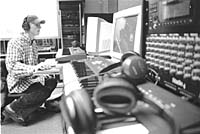
Fatboy Luke is playing in heaven: A TIMARA student searches for the right sound. (photo by photo by Areca Treon)
Copyright © 1999, The Oberlin Review.
Volume 127, Number 25, May 28, 1999
Contact us with your comments and suggestions.