
This year saw continued staff conflicts in the Office of Security, resulting in numerous grievances. In the Fall, Interim Dean of Students Deb McNish intervening in the conflict after the officer's union filed charges with the National Labor Relations Review Board.
McNish stepped in to mediate the disagreement in October after problems within the department were publicized. The Oberlin College Security Association, the union representing Safety and Security officers, had filed between 70 and 80 formal and informal grievances against management in the past three years. McNish took an active role in the department in order to settle the rising tensions.
"There is a lot of pressure on [security] to do the job and do the job well," she said. "To relieve the pressure I'm going to devote more of my time to the department and create my own investigation. I'll be meeting with the entire staff," said McNish.
She continued to meet with personnel on every level, from the director on down to the officers until February. McNish eased up on her active role in the security department when she felt she made progress bringing James and OCSA together over conflicting issues. Despite McNish's work with security, James held the position that his office never really had any problems, while union representatives expressed pleasure over McNish's intervening efforts.
James downplayed the existence of any difficulty within the security department. "To me, there was never a problem," said James. "I am elated she has left the leadership to the management team." McNish believed that management and the officers had succeeded in increasing their communication, and left James to lead his department without any outside intervention. "Anytime you intervene at my level, sometimes you compromise the leadership of the people involved," said McNish.
McNish worked through a whole slate of problems with the security department during her four month involvement. She emphasized reinterpreting the union's new contract, which was signed by the union in July of 1998. Bringing both sides together on an understanding of scheduling matters and other disagreements helped McNish ease the tense situation percolating in the security department. "We worked on changing roles and understanding the contract. About 60 percent of the problems were built around the new contract," said McNish.
To McNish's credit, OCSA calmed down in its rapid fire production of grievances against security management. "Grievances are down, complaints are down. That's a real indication to me that things are getting better," said McNish.
Diewald was concerned when she heard that McNish would cut back on her supervision of the security department. "The union felt that communication improved with the help of an intermediary. I hope that the meetings are going to continue," said Diewald.
OCSA had been using grievances to challenge James and his policies. According to OCSA Vice President Christine Diewald, approximately 75 to 80 grievances have been filed against James in his term as director.
OCSA sighted unsafe working conditions, inappropriate letters of reprimand and blatant contract violations as the contentious highlights of the Security Director Keith James' three year tenure. James claimed that petty grievances created by a minority of individuals in the union cost his office valuable time.
"He is putting the officers into unsafe conditions. He is making threats to them, threatening their job security," said Sandy Naples, a representative from the Office of Professional Employees International Union, OCSA's national affiliate.
Director of Human Resources Ruth Spencer, said that 14 level three grievances had been heard by her office in 1998. Spencer said, "I would say that there are more grievances from this particular union than other unions this year."
James' predecessor, James McDaniel, had only with five grievances from his staff during his 15 years as director of safety and security. None of them got beyond level two, and all were dealt with in the office of safety and security. "It would seem to me that the number of grievances is excessive, and it speaks to some weakness in the organization," said McDaniel.
Spencer did support James' claim that the grievances had come from a minority within the security staff. "There are a smaller number of people who have filed the grievances," said Spencer.
The security department will now have a new supervisor in newly- hired Dean of Students Peter Goldsmith. It remains to be seen if Goldsmith can continue McNish's success in mediating disagreements between management and staff.
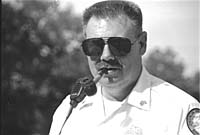
Takin' it easy: After a hard day of work, security officer Gary Krieson takes a moment to relax with his pipe. (photo by Pauline Shapiro)
Copyright © 1999, The Oberlin Review.
Volume 127, Number 25, May 28, 1999
Contact us with your comments and suggestions.