
Over 200 students, faculty and community members filed into the Carnegie Root Room Tuesday night to hear a powerful forum entitled "Toxics in Our Communities." Various speakers, including nationally renowned grassroots activist Lois Gibbs, addressed the topic. The response matched the gravity of the concerns.
"The issue of toxics is a critical one in our society," said College President Nancy Dye as the evening commenced. She informed students that one in four Americans lives within four miles of a toxic waste site.
In Ohio alone, there are 1,192 toxic waste areas, 33 of which are classified as Superfund sites. With a Superfund site in Elyria and a military toxic waste dump in Marion, the problem is closer to us than many college students think.
Beginning in 1997, residents of Marion noticed increasing cancer and leukemia rates among River Valley School graduates and people who lived and worked in the vicinity of the Marion Engineering Depot, an abandoned military operation and the current site of the school.
Studies showed the mortality rate due to leukemia deaths raised 122 percent between 1966 and 1995. Later, a report released by the Army Corps of Engineers found more than 310 times the acceptable amount of trichloroethylene and 228 times the acceptable level of polychlorinated biphenyls had contaminated the area.
While the study was conducted on Nov. 23, 1998, it was not released until Feb. 12, 1999. Contaminants have been discovered on 41 of the 78 acres of the school. The land had been sold to the school board in 1963 for one dollar.
Barry Serpa, a member of the Concerned River Valley Families, a group which works for the clean up and evacuation of the school, shared his story the forum. In 1986, Serpa's wife, a graduate of River Valley School, was diagnosed with level 2A Hodgkin's disease, a form of cancer. She was in remission from 1989 until 1992, when she was pregnant with her second child.
"We wanted to deny it," Serpa said when his wife Melanie discovered a growth on her collarbone, "but we had a gut feeling."
Because she had already been exposed to the maximum amount of radiation advisable for a person to come in contact within a lifetime, Melanie was injected with steroids to maturate the baby's lungs so that it could be born prematurely. She then underwent chemotherapy for nine months and has been free of cancer since 1993.
But Melanie Serpa is just one out of over 100 Marion residents who have cancer. "There's a lot of folks who didn't make it," Barry said during the forum. "That's a big part of why we're here. We have to speak for them because they can't."
In March 1999 government contractors began removing barrels of hazardous waste from the Army Reserve property next to the school's campus. The Concerned River Valley Families have been working every day to encourage Governor Taft to begin the clean up of the school.
Even today, the children of Marion are attending school, being exposed to toxic chemicals with no guarantee of when the area will be cleaned up.
"It's time - past time - to take a much stronger stand," said Gibbs later in the program. Gibbs is the founder and Executive Director of the Center for Health, Environment and Justice.
She speaks of toxics, as well as to the people of Marion, with the empathetic soul of a mother whose children have also been exposed to toxics.
After living in Love Canal, New York, both her children contracted various diseases. Michael, at the age of one year, was epileptic and had a depressed immune system. Her daughter Melissa acquired a blood disease and was diagnosed with leukemia.
Her town was built on a toxic waste dump. Like the people of Marion, residents of Love Canal were being exposed to toxic chemicals in much greater quantities than are acceptable.
In 1978, Lois, a then 27-year-old housewife, organized her town into the Love Canal Homeowners Association and struggled for relocation.
However, the group met a formidable opposition, including Occidental Petroleum (the chemical manufacturer), local, state and federal government officials. All insisted that the leaking chemicals including dioxin, the most toxic chemical known to man, was not the cause of the high rates of birth defects, miscarriages, cancers and other health problems. After doing a cost-benefit analysis, the government decided that even cleaning up the dump, a measure that would have cost $20 million dollars, was not worth it.
"All across the country, people are being sacrificed for dollars and cents," Gibbs said at the forum, as if reliving her frustration.
After telling about a study her group conducted and politicians disregarded, one which found out that 56 percent of all Love Canal children were miscarried, stillborn, or mentally retarded, she said, "This was not a fight about people's health or a scientific debate, it was about a political debate."
In 1980 President Jimmy Carter finally delivered an emergency declaration which evacuated 900 families from Love Canal. Today, Gibbs uses her experience to organize people affected by toxic chemicals.
Because of the organizing efforts of sophomore Yuri Futamura and junior Mark Minett, toxics campaign coordinators of the Ohio Public Interest Research Group and the organizers of the forum, Gibbs was able to meet with the people of the Concerned River Valley Families.
Additionally, the forum was an opportunity for the co-sponsoring groups to come together and talk about the experience they've had with toxics in our communities. Some of these groups include Ohio Citizen Action, Buckeye Environmental Network and OPIRG.
"If we can exchange similar stories of our struggles and share strategies and tactics that have proved effective with these organizations, we can create massive grassroots pressure on Governor Taft to take action on the Marion case," Futamura said.
Gibbs said, "There are communities all across the state that can't do it all by themselves," and went on to say how we live in a democracy, and we need to take this country back. The corporations are the ones making the decisions, yet we are the ones being contaminated and poisoned.
"Years ago, the environmental movement was put in the forefront by young men and women just like you," Gibbs concluded. "I am challenging you. Challenging that you get involved in any way you can; the environmental movement needs campus students to get involved in the issues. You need to stand up and say 'enough' because you too are being poisoned."
By using our abilities to organize as students and to influence politicians as voters, Gibbs urged that we can move to change the system.
"I want my children to be able to raise their children in a democracy," Gibbs said.
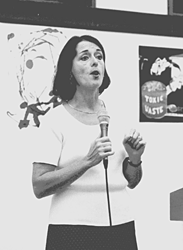
Talkin' toxin: Lois Gibbs, a well-known grassroots activist, spoke Tuesday on toxics in our communities, noting that one in four Americans lives within four miles of a toxic waste sight. (photo by Areca Treon)
Copyright © 1999, The Oberlin Review.
Volume 128, Number 12, December 10, 1999
Contact us with your comments and suggestions.