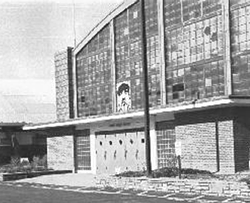

Spring sports have always entertained a feel-good nature. The trees begin budding, the annual North Field tundra begins to melt, and ah yes, everyone remembers those lengthy practices in Jones Fieldhouse, nicknamed by many as "the Dust Bowl." But Jones athletes must no longer revert to Breathe-Right nose strips for clear lungs. During Winter Term the fieldhouse will be power-washed before a state-of-the-art brand Astroturf is laid down.
The Astroturf, called Safeturf, is different from a basic turf that is used in most college football fields. According to Athletic Director Mike Muska, Safeturf is a new product that is softer and more resilient than normal turf. "It hasn't been tested that much," he said, "but we have a 10-year guarantee." Safeturf has a rubber base with pseudo sod-like dirt and longer, thinner "grass" for more give - an especially important feature for constant wear and tear on the legs. This new turf also features a seam underneath for drainage purposes.
Presently, the College is working on preliminary projects to prepare for the restructuring. "We've had new drainage put outside the building [Jones] due to run-off from the hockey rink," said Muska. "We are going to have the place power-washed to get all the dust out."
The Safeturf is being made as we speak, and the restructuring will begin right after New Year's. "Right after the first of the year, they're coming in," said Muska. "It will be a two-week installation and they have guaranteed that it will be ready by the first week in February."
The turf will also feature a 10-foot "warning track" around the perimeter. The warning track will be painted white - a lookout for athletes who are running at full speed towards the wall.
The construction will not interrupt any varsity sports. All of the winter sport teams practice in Phillips and the spring sports do not "officially" begin until February. Community activity, such as little league and softball will have to relocate, but their will be no College related setbacks.
"We're very excited about Jones being turfed. It will definitely improve our preseason," said senior Sarah Bergman, a veteran to not only the women's lacrosse team, but the noxious dust of Jones. "It's a different, faster game when the ball bounces. But we will miss the old Jones, the rodeo rink. It had a lot of character," said Bergman.
Junior Jesse Cretaro of the men's lacrosse team had a matter-of-fact view of the closure of the 'Dust Bowl.' "I give my final farewell to the Dust Bowl. It's historic, that place - it should be nuked. But putting down turf will do for now," he said.
The reconfiguration is not an abnormality. Its practical uses are apparent to both the varsity sports teams that use it in the spring and the club sports and local community leagues that practice there. But one must not overlook the instant progress that Muska has made. His first two short-term initiatives were to build a softball field and fix up Jones. Both projects have been completed in just one semester.
The short-term effects of the new building are obvious: less of a time constraint for maintenance purposes as well as multi-purpose use. "I have visions of a four to 12 midnight practice regime every day," said Muska. "I can see pitchers and catchers, lacrosse, field hockey, soccer, ultimate frisbee, recreation and club sports."
"Jones will be less of a time constraint in terms of maintenance," said baseball Head Coach and Assistant Recreation Center Director Eric Lahetta. "We won't need anyone to water it now."
Muska is also taking an aggressive role in other structural changes. "It would be wonderful to have a lighted soccer field, or even a press box," said Muska. "But spending $110,000 on this project, what an investment for us."
Muska stressed the tangible, rather than the fantastical solution. Why replace Jones for $5 million when we can fix it up for a fraction of the price and use that money for another project down the road?
Not only does the reinvigoration of what many call "an old, antiquated warehouse" help immediate goals, but other facets of athletics, like recruiting, will be affected as well.
"Whether it's a new building or field, when there's a visibility that things are starting to change in athletics and when people see those things happen, then you see commitment," said Muska.
Lahetta agreed with Muska on the recruiting issue. "Definitely having a facility where players are coming in and seeing it in great shape is a huge tool."
Head Coach Elizabeth Graham of the women's field hockey and lacrosse team's also found an advantage. "It's something that we've needed and it can be used as a recruiting tool. No one else in the NCAC has a facility like ours. We are ahead of our competition," said Graham.
The safety of the new turf is an aspect that often gets overlooked. For baseball, ground balls will now be true and players will not have to worry about bad hops. "It will be safer for fielding ground balls," said junior Chris Irish. "Dirt creates a dangerous atmosphere for errant grounders."
"The impact on injury prevention is greater," Graham said.
One athlete was less concerned about the safety. "I love the idea, I can't wait to feel the speed and agility one gets from turf, despite its danger for the knees and the scary speed it puts on the ball, especially in such a small area," said sophomore Isaiah Chase, a member of the men's lacrosse team.
The other major plus that Chase alluded to is that teams get to practice on their game-type surface. The lacrosse teams, and baseball and softball to a lesser extent, now get the luxury of a cold-weather indoor arena that mimics the atmosphere of their normal playing surface.
"This is a much more realistic playing surface," said Coach Graham. "For example, ground ball drills on turf will be more similar to grass fields."
"We play games on turf during our season and never have gotten much of a chance to practice on it before - it's a different, faster game when the ball bounces," said Bergman. "Last year our championship game was on turf."
"It will make the cold weather practices much more productive. It will allow us to play on a surface that lacrosse is supposed to be played on, not dirt," said senior Lydia Ries, a proud member of the women's lacrosse team. "After all, we're not horses, most of us anyhow."
Jones Fieldhouse: some may call it just a simple project that required a much-needed change. But there is no denying the progress that the Athletics Department is making. Some fall sports enjoyed their best seasons in a long time. The coaching changes have proved to added a solid foundation for rebuilding programs like football and soccer, even if their records do not show it.
Finally, the upgrades to facilities have begun, a process of conscious, methodical, financial decisions that have proved to be for the better. Oberlin can no longer be looked upon as strictly an academic institution.
This old fieldhouse: Jones should look a little younger when students return for second semester. (photo by Gitta Zomodori)
Copyright © 1999, The Oberlin Review.
Volume 128, Number 12, December 10, 1999
Contact us with your comments and suggestions.