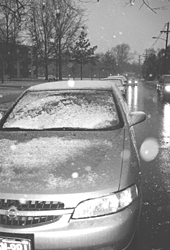

Oberlin's snow ban, prohibiting parking on city streets from 2 p.m. to 6 a.m. is now in effect. The ban technically became effective Dec. 1, although warnings have been minimal so far.
Since 1973, the Oberlin city ordinance has stipulated that the ban begin Nov. 1 and end April 1. Although this year the ban will end on the same date, City Manager Rob DiSpirito recommended that Oberlin's City Council push the beginning date back to Dec. 1. "To me it just made sense. And the police department had no objections," DiSpirito said. He said he suspected that weather patterns in 1973 were vastly different than those today, and that a November snow ban was likely practical and necessary then. DiSpirito cited the recent pre-seasonal weather in November as a chief reason for his recommendation. Moreover, DiSpirito said he realizes the hardships a November snow ban placed on students, and hopes that the one-month delay will help.
Although the ban has technically begun, the police force is still in the process of issuing preliminary warnings. DiSpirito attributed this to a current lack of manpower on the police force. He explained that illegally parked vehicles will receive warnings prior to tickets, and that usually three tickets warrants a tow. "It all depends on the availability of tow trucks at the time," said DiSpirito, "If the owner of the vehicle shows a blatant disregard of the ticketing, they will be towed." DiSpirito remarked that if Oberlin were suddenly bombarded with snow, the city would not vigorously enforce parking regulations this early in the ban. "The bottom line is that if it were to snow right now we wouldn't tow. We would just try and plow around the cars," he said.
DiSpirito did stipulate that the city does not hesitate to tow student vehicles illegally parked overnight in the City Hall parking lot and at the Mudd library parking lot. "Parked cars in those lots are not acceptable because someone pays to have those lots plowed," he said.
DiSpirito admitted to the serious problems of the current student parking situation. He claimed that in 1997, the College conducted a study of campus parking where consultants advised the College that it needed at least 200 additional parking spots. He was unsure as to whether the College had yet addressed the issue. DiSpirito expressed discontent at the College's lackadaisical manner in dealing with the parking problem. "When the College builds new buildings they don't build enough parking spots to correspond...but it's something we're used to," he said. DiSpirito cited a "gentleman's understanding" between the College and the city in the late 1980s and early 1990s where the College committed to expand parking to correspond to the construction of new campus buildings.
According to DiSpirito, Oberlin's city planning commission hopes to address and resolve parking issues. He hopes to decrease the need for students to park in the Conservatory parking lot during the day, as it reduces the ability for turnover in those limited spots, financially harming town businesses.
Director of Security Keith James also cited multiple problems with the current parking situation. He mentioned the lack of spaces near residential halls as the most pertinent issue, saying many students have complained of long walks from the parking lots to their dorms. James said, "My biggest concern is a basic lack of parking for students on the south side of campus. There just aren't enough parking lots close to those dorms."
He stressed that Security has strongly encouraged all students to register their vehicles so they can know exactly whether more spots are necessary. "Without 100 percent registration we really can't know," said James. To combat this problem, Security has issued all-campus mailings encouraging students to register vehicles. Security also keeps a booth during orientation encouraging students to register vehicles at the beginning of the semester. Moreover, James asserted that Security will continue with rigorously issuing tickets to non-registered vehicles occupying reserved spots.
However, James stressed Oberlin's status as a primarily walking campus. He said, "We know that lack of parking is an issue, especially for those on the south side of campus...but really, Oberlin is a walking campus."
Make way for the plow: The snow ban this year was pushed back for a month, but violators will now be ticketed. (photo by Rachel Pillsbury)
Copyright © 1999, The Oberlin Review.
Volume 128, Number 12, December 10, 1999
Contact us with your comments and suggestions.