
We've all heard the terrifying rumors. On Jan. 1, 2000, the world of computer technology will supposedly face its own day of reckoning as the dreaded Y2K bug wreaks havoc on governments, businesses and internet porn sites throughout the world. If those rumors are true, the effects will be devastating. Stock markets will crash. The trains will no longer run on time. And mannequins with magic bracelets will come to life, searching for solace in the arms of wacky department store clerks.
Although the paranoia surrounding the advent of the 21st century and its impact upon the information superhighway has flooded the media during the past few years, residents of Oberlin have little reason to fear the future. Despite its reputation as a sleepy, backward college town located in the middle of nowhere, Oberlin is, in fact, a progressive community that is fully prepared to withstand the horrors of the Y2K syndrome.
A recent survey of local restaurants revealed that quality food will still be available to Oberlin residents, even in the year 2000. Paul Jambor, the proprietor of Pauly's East Coast Pizza, claimed that his young business will not be affected by the Y2K phenomenon. "As far as I know, we'll be fine," he said. Meanwhile, Jason Adleman of the Feve expressed a similar lack of concern. "Absolutely, we will not have any problems with Y2K," he said. "But I guess we'll find out."
Better yet, local crimefighters will not face any new, Y2K-related obstacles in their pursuit of a kinder, gentler community. Asked if the computers down at the crime lab were ready for the New Year, Sergeant Kyle Mitchell of the Oberlin Police had this to say: "Yes."
For its part, the College has taken the necessary precautions to relieve its students and faculty of any Y2K headaches by replacing its outdated computer equipment and networking systems with new and improved software. "We are Y2K compliant," said sophomore Colin Booy, a computer consultant at the Irvin E. Houck Center for Information Technology. "Most of what's running at the college is pretty new, like the iMacs and the Windows machines. We also use Novell networking, which is new. So if we are not 100 percent compliant, the vast majority of our technology is, since all the old machines have been replaced."
Senior Tyler Kord, an employee at the Wilder Student Union known more for his breathtaking dance moves than his technological expertise, shared that optimism. "We have taken all precautions to prevent a Y2K disaster," he said. "The computer systems are all set up, but in the case of an emergency, we have an unbelievable stash of Ramen noodles and canned food hidden in back of the Rat. The porch heaters under the stairs are also Y2K compliant." Similarly, junior 'Sco manager Josh Faught seemed confident that students will continue to dance and drink the nights away well into the next century. "I think everything except for the popcorn machine is ready for Y2K," he said. "On the popcorn front, we're expecting a meltdown."
Although employees at Wilder and the computing center insisted that Y2K poses no serious threat to the college community, others were unable to determine the likelihood of an imminent Y2K disaster. Senior David Tamarkin, the general manager of WOBC, seemed bewildered by the prospect of the New Year and its ramifications for the future of college radio. "Are we Y2K compliant?" he mused. "I have no idea. Sure." But while the future of the Oberlin airwaves is uncertain at best, student bowlers can take comfort in the fact that the College Lanes will survive into the next millennium, even if its vintage beige wallpaper does not. "Oh yeah, we're Y2K compliant," said senior Ryan Keenehan, an employee at the Lanes. "Our pinsetters are not connected to any kind of computer."
Thankfully, student publications will also join the ranks of the survivors. Despite his initial shock at the mention of Y2K, Khary Oronde Polk, editor-in-chief of The Dial, does not believe that the infamous bug will affect the production of his literary magazine. "Wow. Shit. Fuck," he said. "Oh man. I'm really out of it. I think we will survive Y2K. But it doesn't really matter because art and literature will exist for all time." Senior Benjamin Dagnon, the computer manager at the Review, offered a more technical analysis of the situation. "The Review is going to be absolutely okay because we use Macintoshes and all of our software has been Y2K complaint for years," he said. "Please love me."
Finally, the most sacred art - procreation - will still be safe in the new millennium. The Sexual Information Center, which provides students with contraceptives and other sexual devices at bargain prices, has bolstered its collection of space-age vibrators and penis enlargers for the next millennium. "S.I.C. is definitely Y2K proof," said senior counselor Madeleine Moule. "Our sex toys will continue to perform, and our supply of latex and lube should be enough to keep everyone on campus safe and satisfied."
While the Oberlin community has done well to protect itself from the impending doom that is Y2K, the College still must rely on businesses from outside the local area to provide a variety of invaluable services, a fact that has caused more than a few headaches within the administration. Karen Long and Jan Eastman, the duo responsible for ordering student textbooks, are just two of the College employees who wonder if their jobs will be complicated by the turn of the century. "Will Y2K affect the publishers?" Long asked. "Maybe. The publishers say no. But am I skeptical? Yes. We'll find out on Jan. 2."
Like all of us, Long and Eastman can only wait to see how Y2K madness will affect the small, isolated universe of Oberlin. But never fear folks; despite all the dreadful rumors you may have heard, the future looks impossibly bright for residents of our sleepy little collegetown.
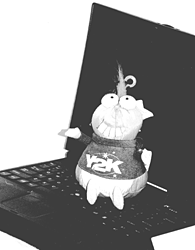
Are you Y2K compatible? Most local business owners and College departments are ready for Y2K. (photo by Pauline Shapiro)
Copyright © 1999, The Oberlin Review.
Volume 128, Number 12, December 10, 1999
Contact us with your comments and suggestions.