
Ripin Gallery
July 30–December 15, 2019
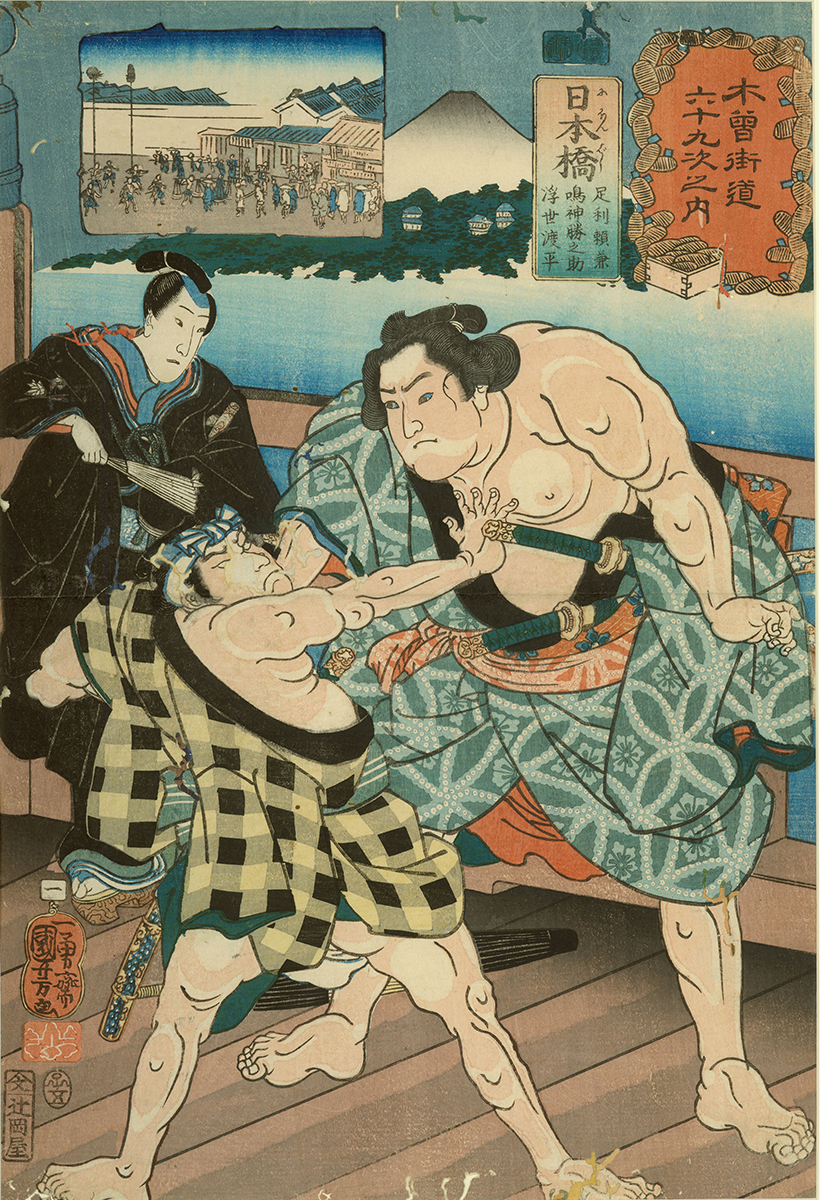
For centuries, Japanese artists have conveyed political messages in their artwork. This exhibition examines the kinds of works produced both under censorship laws and without them, and the ways in which these works challenged the government and other societal structures of power.
The exhibition title references the term veiled dissent, coined by scholar and curator Sarah Thompson. It refers to the careful ways the artists of the Edo Period (1603–1868) modified images and text in their popular woodblock prints to address subjects that were restricted by censorship laws of the era. Similar political censorship extended into the late 19th and 20th centuries, through the post-World War II occupation period. Rather than definitively getting rid of certain subject matter, artists instead became more creative in how they delivered their messages.
Unveiled dissent refers to art created without the bounds of censorship laws, after the death of Emperor Hirohito (1901–1989). Reflection on the legacy of WWII and the interactions of Western and Japanese cultures led to the rise of art that was more outspoken politically, as Japanese people negotiated the past and the present in creating a new Japan.
Organized by Leina Fieleke ’21, curatorial assistant in Asian art, with Kevin R.E. Greenwood, Joan L. Danforth Curator of Asian Art.
Image: Utagawa Kuniyoshi (Japanese, 1797–1861), "Nihonbashi: Ashikaga Yorikane, Narukami Katsunosuke and Ukiyo Watahei on Nihon Bridge, no. 1" from the series "The Sixty-nine Stations of the Kisokaidō," 1852, color woodblock print. Mary A. Ainsworth Bequest, 1950.589