
Willard-Newell Gallery
Through July 21, 2019
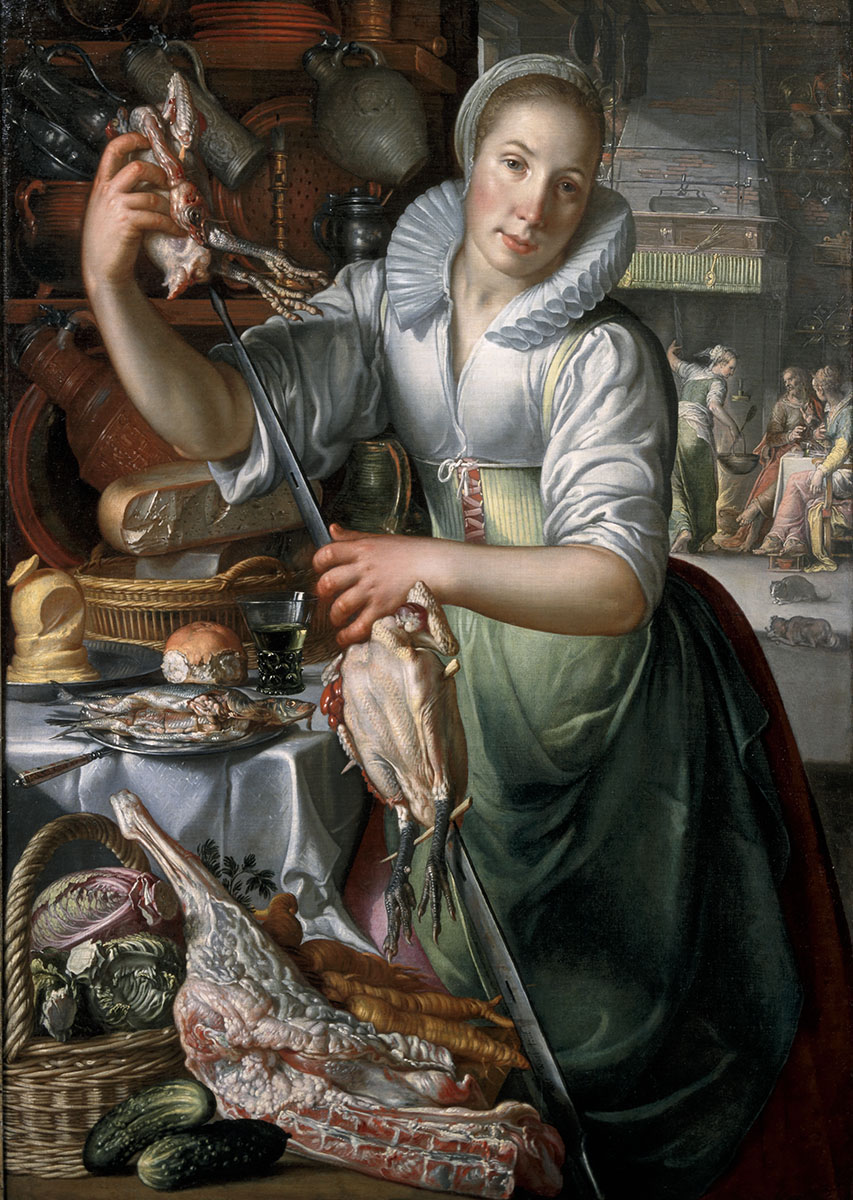
Two 17th-century Dutch paintings are trading places this spring and summer as part of a reciprocal loan agreement.
The AMAM’s St. Sebastian Tended by Irene, by Hendrick Ter Brugghen, will be on view in Utrech and Munich as part of the touring exhibition Utrecht, Caravaggio, and Europe. In its place visitors can see The Kitchen Maid, a striking example of Dutch Mannerism by artist Joachim Wtewael (1566–1638). The painting has been loaned by the Centraal Museum, Utrecht, the Netherlands.
In the painting, a robust maid skewers plucked chicken carcasses amid a sumptuous display of foodstuffs in the foreground, while the biblical episode of Christ visiting the house of Mary and Martha (Luke 10:38–42) unfolds in the distance. Christ praises Mary for listening to his teachings rather than being distracted by her daily work, as is Martha. Here we see a scene from everyday life combined with a moralizing biblical subject, a tradition established by such 16th-century Netherlandish painters as Joachim Beuckelaer and Pieter Aertsen.
The contrast between the painting’s religious and secular components would seem counter to our expectations. But for the 17th-century viewer, the juxtaposition of earthly and moral realms was justified. Typical of Dutch Mannerism, Wtewael’s hyper-exact style of painting, highly keyed colors, and artful contortion of the maid’s figure heighten the sensual, even vulgar, aspects of the foreground elements. The lavishly rendered table laden with cheese, butter, fish, and vegetables is purposefully tempting, while the scene in the background offers a corrective perspective.
Image:
Joachim Wtewael (Dutch, 1566–1638), "The Kitchen Maid," ca. 1620–25, oil on canvas. Collection of the Centraal Museum, Utrecht, the Netherlands. Purchased with support of the Rembrandt Association, the Mondriaan Foundation, and many others, 1999, inv.no. 28599