
Stern East
September 24–January 12, 2019
.
Fin-de-siècle Vienna was a city at turns politically conservative and culturally and intellectually radical. One of the capitals of the waning Austro-Hungarian Empire, Vienna also gave rise to Freudian psychoanalysis, experimental music composition, and Expressionist art and literature. It was within that context that the painter Gustav Klimt, along with a number of other artists, designers, and architects, co-founded in 1897 the Vienna Secession, which rejected the outmoded norms of the academy and sought to bring so-called high art into communion with decorative art. Klimt’s work was indeed revolutionary in its time, not only stylistically, but also thematically. He articulated a boldly sensual and interiorizing approach to the female figure at a moment when gender roles were changing dramatically, so much so that women were referred to as a Störfaktor der Gesellschaft—a disruptive factor in the social order, a term that could also fairly describe Klimt and his contemporaries.
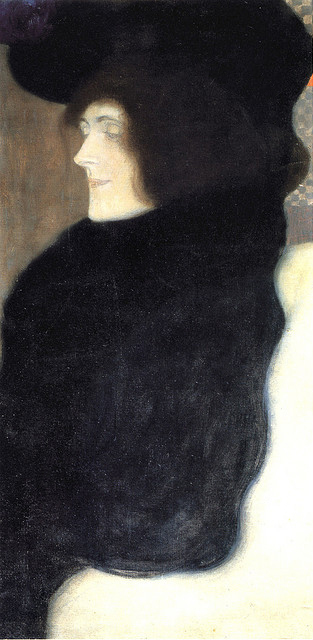
Here, Klimt’s 1903 painting Pale Face, on loan from the Neue Galerie in New York, is placed in dialogue with works from the AMAM collection. A number of these works were bequeathed to the museum by Elisabeth Lotte Franzos, who hosted a salon for artists, writers, and politicians, and who counted among her friends the artist Oskar Kokoschka. Together these paintings, drawings, and photographs offer a taste of Vienna circa 1900, a place considered by many as one of the birthplaces of modernism.
Organized by Andrea Gyorody, Ellen Johnson ’33 Assistant Curator of Modern and Contemporary Art, with Amy Baylis ’20.
Image: Gustav Klimt (Austrian, 1862–1918), "Pale Face," 1903, oil on canvas. Neue Galerie New York. This work is part of the collection of Estée Lauder and was made available through the generosity of Estée Lauder. Inv. no.: EL41